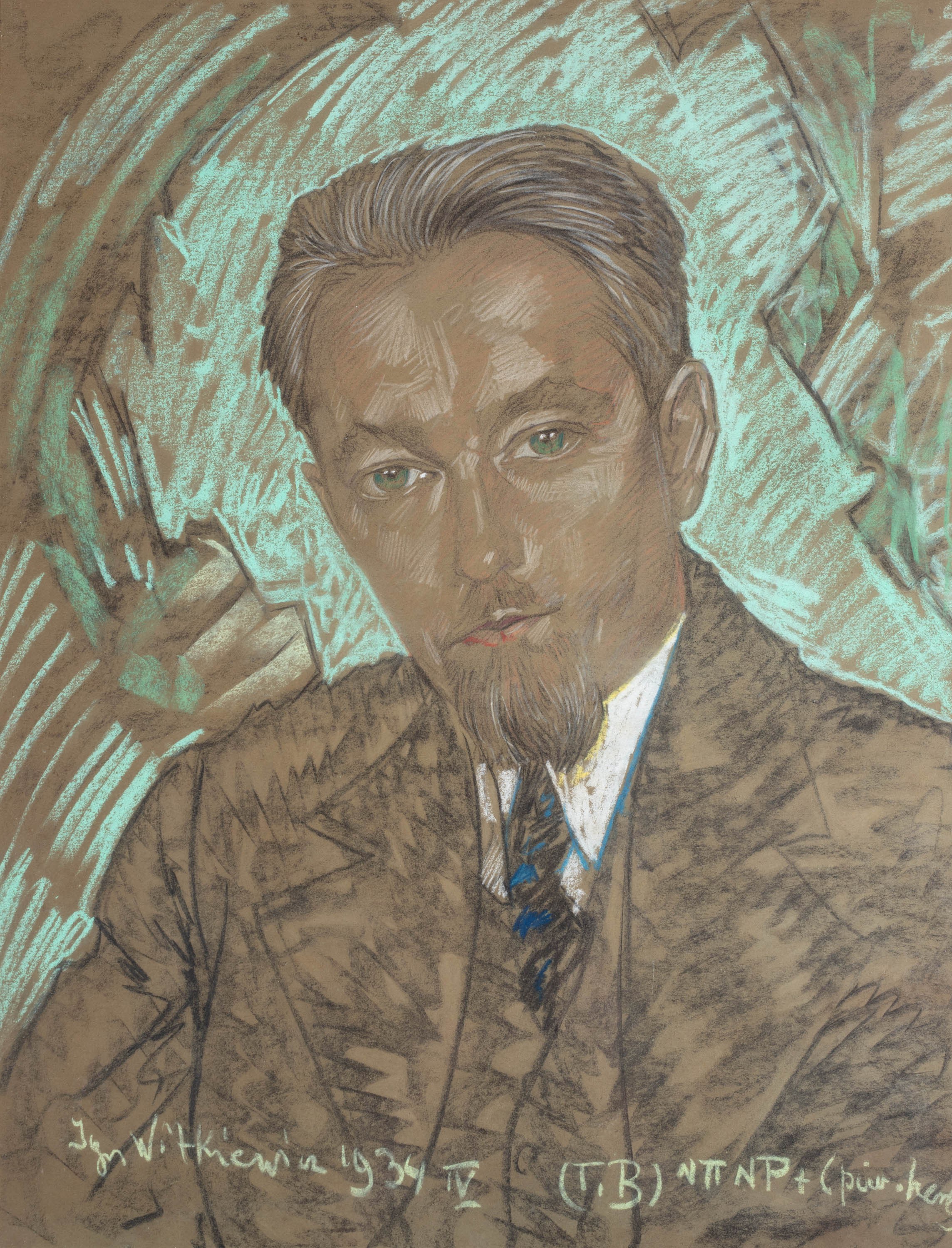
pastel on brown paper, 63.60 × 48.20 cm,
signed, dated, and inscribed at the bottom: "Ign Witkiewicz 1934 IV (T.B) Nπ NP. + (beer.coat of arms)"
The painting is accompanied by a copy of an expert opinion by Witkacy scholar Dr. Anna Żakiewicz (curator and author of numerous exhibitions and publications on Witkacy, curator of the Witkacy collection at the National Museum in Warsaw)
Described in:
– “Stanisław Ignacy Witkiewicz 1885–1939. Catalog of Paintings,” ed. I. Jakimowicz, Supplement: I. Identified Works, item 24, p. 156 (listed as Portrait of a Man with a Goatee, April 1934)
This pastel by Witkacy was photographed by Franciszek Czerwiński, who ran his own photography studio in Nowy Sącz and, at the artist’s request, documented the portraits created there. In his correspondence with Helena and Franciszek Maciak, with whom Witkacy stayed during his time in Nowy Sącz in the first weeks of April 1934, he was referred to as Franz von Czerwiński. During this period, the artist painted a portrait of Czerwiński’s wife, and during his next visit in 1938, he also painted Franciszek himself in the uniform of an officer of the 1st Podhale Rifle Regiment, as well as their son Stanisław. A photograph of the pastel on offer survived until the 1980s in the photographer’s archive and was made available in 1988 for the purposes of a catalog summarizing Witkacy’s artistic oeuvre, which was then being prepared by Irena Jakimowicz in collaboration with Anna Żakiewicz (“Stanisław Ignacy Witkiewicz 1885–1939. Catalog of Paintings,” ed. I. Jakimowicz, Supplement: I. Identified Works, item 24, p. 156 as “Portrait of a Man with a Beard,” April 1934.). Witkacy’s Nowy Sącz period resulted in as many as 50 portraits, half of which were identified thanks to photographic documentation from Czerwiński’s studio.
“Between April 7 and 20, 1934, Witkacy stayed in Nowy Sącz, where he completed a series of portrait commissions. Due to the conservative tastes of his clients there, these portraits are drawn with extraordinary care, with great attention paid to capturing both the models’ physical appearance and their psychological characteristics. Their execution was labor-intensive, so the artist—as he reported in letters to his wife—drank a lot of tea at the time, to which he attributed invigorating properties that allowed him to conduct as many as 3–4 portrait sessions a day. He, in turn, readily soothed the resulting overstimulation—which he called “tea-osis”—with beer. The portrait includes a note about the consumption of both of these beverages, which clearly served their purpose. The portrait is meticulously rendered and highlights the model’s individual features—a slight asymmetry in the face and the hint of a smile visible especially in the left eye. As a result, the man’s face has a unique expression and demonstrates Witkacy’s mastery in this regard.” Excerpt from the expert opinion by Dr. Anna Żakiewicz
The portrait was executed in Type B, which, according to the regulations of the Portrait Company, called for: “a more characteristic style, yet without a trace of caricature. A style more linear than Type A., with a certain exaggeration of characteristic features (...). An objective approach to the model.” (B. Zgodzińska-Wojciechowska, A. Żakiewicz, “Witkacy: The Collection of Works by Stanisław Ignacy Witkiewicz at the Museum of Central Pomerania in Słupsk,” Warsaw 1996, p. 33). The cost of commissioning such a portrait was 250 zł in pre-war currency, which was equivalent to a decent monthly salary at the time.










Visti di recente
Accedi per visualizzare l'elenco dei lotti
Preferiti
Accedi per visualizzare l'elenco dei lotti